
The dishwasher finishes the cycle. There are no obvious error messages. The dishes may even look clean at first glance. But when you pick up a plate, glass, or utensil, something feels wrong — there is still a greasy film on the surface.
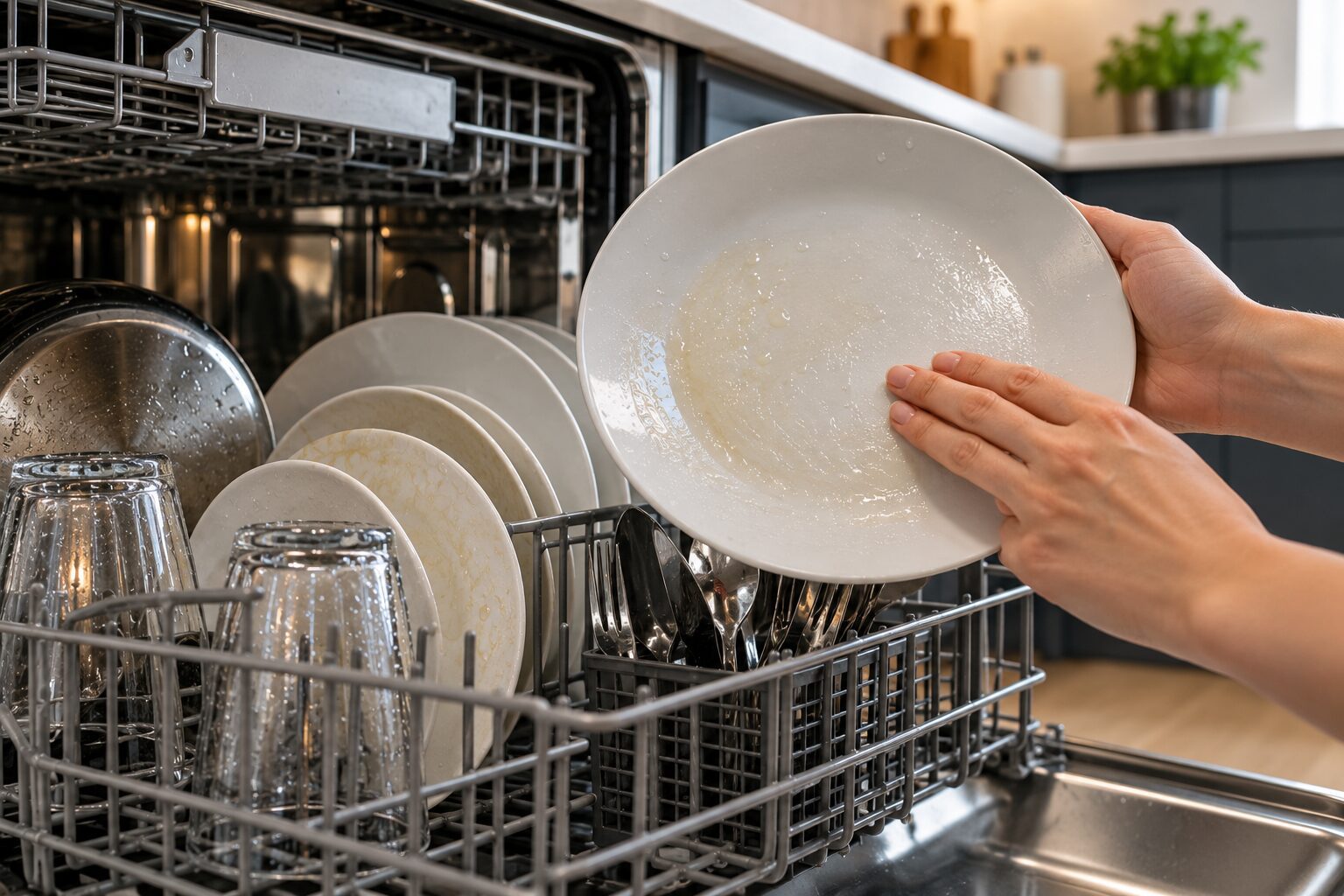
When this happens repeatedly, running another cycle may help temporarily — but it does not explain why the dishwasher is no longer removing grease the way it should.
The cause may be as simple as incorrect loading or a dirty filter. But consistently greasy dishes can also point to problems with water temperature, spray performance, water supply, or circulation inside the dishwasher.
1. The Water May Not Be Hot Enough
Hot water plays an important role in breaking down grease and helping dishwasher detergent work effectively. If the water entering the dishwasher is not hot enough, the machine may complete every stage of the cycle while still struggling with oily residue.
You may notice:
- ●Grease remaining on plates and cookware
- ●A film on plastic containers
- ●Detergent not dissolving as expected
- ●Poor results after heavily soiled loads
- ●Dishes that seem less clean than they used to
Household water-heater settings, plumbing conditions, the distance between the water heater and dishwasher, or hot-water use elsewhere in the home can affect the temperature of incoming water. Some dishwashers also use an internal heating system during portions of the cycle.
2. The Spray Arms May Not Be Cleaning the Dishes Properly
A dishwasher depends on pressurized water moving through its spray arms to reach dishes throughout the racks. If the spray arms cannot rotate properly or some of their openings are restricted, parts of the load may receive much less washing action than they should.
You may notice:
- ●Some dishes are clean while others remain greasy
- ●Items in one rack clean better than items in another
- ●Food residue repeatedly remains in the same areas
- ●Spray arms do not appear to move freely
Before starting a cycle, make sure dishes, utensils, pan handles, or tall items are not physically blocking spray-arm movement. Accessible spray openings can also be inspected for visible food debris or mineral buildup.
3. The Dishwasher Filter May Be Dirty
Many modern dishwashers recirculate water during portions of the wash cycle. The filtration system helps keep food debris from being redistributed onto dishes. When the filter becomes heavily soiled or restricted, cleaning performance can suffer.
A dirty filter may contribute to:
- ●Greasy dishes
- ●Food particles remaining after washing
- ●Unpleasant odors
- ●Residue inside the dishwasher
- ●Poorer cleaning over time
4. Detergent Can Make a Bigger Difference Than You Think
Not every cleaning problem is mechanical. Dishwasher detergent needs the right combination of water, temperature, circulation, and dosage to work effectively.
Consider:
- ●Whether the detergent is appropriate for your dishwasher
- ●Whether the amount matches the load and water conditions
- ●Whether the detergent is fresh and stored properly
- ●Whether the dispenser opens normally
- ●Whether detergent remains in the dispenser after the cycle
Using too little detergent may not provide enough cleaning power for greasy loads, while simply adding more is not always the answer. Excess detergent can create residue problems of its own.
5. The Dishwasher May Be Loaded in a Way That Blocks Water
A dishwasher can be full without being overloaded. The difference is whether water can still reach the dirty surfaces.
Large bowls, cutting boards, pots, pans, and serving dishes can block spray patterns. Plates placed too closely together may shield each other, while tall utensils can interfere with spray-arm rotation.
Before starting the cycle, make sure:
- ●Plates are not packed tightly together
- ●Bowls are positioned so water can reach the inside
- ●Large items are not shielding smaller dishes
- ●Tall items do not block spray arms
- ●Utensils are not nested together
- ●Nothing prevents the detergent dispenser from opening
6. The Dishwasher May Not Be Getting Enough Water
Good cleaning requires more than hot water. The dishwasher also needs the correct amount of water. If the machine is filling with less water than expected, spray pressure and circulation can be affected.
The dishwasher may still start, wash, drain, and finish without an obvious failure. But cleaning performance can gradually become worse.
Possible signs include:
- ●Cleaning performance suddenly becomes weaker
- ●Spray action sounds different than before
- ●Dishes throughout both racks remain greasy
- ●The dishwasher seems unusually quiet during washing
- ●Wash results vary from cycle to cycle
Possible causes can involve the water supply, inlet valve, supply line, or other components responsible for filling the dishwasher.
7. The Circulation Pump May Not Be Moving Water Effectively
The circulation pump is responsible for moving wash water through the dishwasher’s spray system. When circulation is strong, water reaches the dishes with enough force to help remove food and grease.
If pump performance becomes weak or inconsistent, the dishwasher may still complete the entire cycle while producing disappointing results.
8. The Selected Cycle May Not Match the Load
Short, quick, or energy-saving cycles can be useful for lightly soiled dishes. They may be less effective when dealing with cookware, dried-on food, or heavy grease.
If the dishwasher performs well on a normal or heavy cycle but struggles on a quick cycle, there may not be an appliance failure at all. But if dishes remain greasy even after an appropriate full cycle, it is worth looking deeper.
9. Hard Water or Mineral Buildup Can Affect Performance
Minerals in the water can gradually accumulate on internal dishwasher components. Over time, buildup may affect spray openings, heating surfaces, filtration areas, and other parts involved in washing.
Hard-water residue usually appears different from grease — often as white spots, cloudiness, or a chalky film — but mineral buildup inside the dishwasher can still contribute to declining wash performance.
What Greasy Dishes Can Tell You
| What You Notice | Possible Cause | First Step |
|---|---|---|
| Grease remains after most cycles | Water temperature or circulation issue | Try an appropriate full cycle and check hot-water supply |
| Only some dishes stay greasy | Blocked spray pattern or loading | Rearrange the load and check spray-arm movement |
| One rack cleans worse | Spray-arm or circulation issue | Inspect accessible spray components |
| Food and grease remain together | Filter or circulation problem | Check and clean the accessible filter |
| Detergent remains in dispenser | Dispenser, loading, or water issue | Make sure nothing blocks the dispenser |
| Dishwasher sounds weaker during washing | Water-fill or circulation issue | Professional diagnostics may be needed |
| Both racks suddenly clean poorly | Water supply, heating, or circulation problem | Check basic conditions and schedule service if it continues |
What Can You Safely Check Yourself?
Before scheduling dishwasher repair, there are several simple things you can check:
- ●Run hot water at the kitchen faucet before starting the dishwasher
- ●Check whether the spray arms can rotate freely
- ●Make sure dishes are not blocking the spray arms
- ●Inspect accessible spray openings for visible debris
- ●Clean a homeowner-accessible filter according to the manufacturer’s instructions
- ●Review how the dishwasher is loaded
- ●Make sure the detergent dispenser is not blocked
- ●Try a normal or heavy cycle instead of a quick cycle
- ●Listen for changes in the sound of water circulation
When Is It More Than a Dirty Filter or Bad Loading?
One greasy load is not necessarily a reason to schedule repair. Maybe a large pan blocked the lower spray arm. Maybe the dishwasher was overloaded. Maybe the selected cycle was too short for the amount of grease on the dishes.
A repeated pattern is more important. If the dishwasher used to clean the same dishes well and now consistently leaves them greasy — despite proper loading, a clean filter, suitable detergent, and an appropriate cycle — something about its performance may have changed.
When Should You Call a Professional?
Consider professional dishwasher diagnostics if:
- ●Dishes consistently remain greasy after a full cycle
- ●Both racks are cleaning poorly
- ●Water circulation sounds weaker than before
- ●The dishwasher does not seem to be getting enough water
- ●Cleaning performance has gradually declined
- ●The filter and accessible spray arms are clean
- ●Proper loading and detergent changes make no difference
- ●The problem keeps returning after basic cleaning and maintenance
Don’t Keep Rewashing the Same Dishes
When dishes come out greasy, the easiest response is often to run the dishwasher again. But if this becomes normal, the extra cycles are masking the problem rather than solving it.
A dishwasher should not routinely need two complete cycles to clean an ordinary load. If the same loads that used to come out clean now require rewashing, it may be telling you that water temperature, spray pressure, circulation, filling, or another part of the wash process is no longer performing as expected.
Dishwasher Finishes the Cycle but Dishes Still Feel Greasy?
Prime Fix provides professional dishwasher diagnostics, maintenance, and repair throughout San Francisco and the Bay Area. We can evaluate water filling, temperature, filtration, spray performance, circulation, pumps, and other components to identify why your dishwasher is no longer cleaning properly.
Dishwasher Repair in San Francisco & the Bay Area
If your dishwasher completes the cycle but dishes still feel greasy, Prime Fix can help determine what is affecting its cleaning performance.
Prime Fix provides professional dishwasher diagnostics, maintenance, and repair throughout San Francisco and the Bay Area.
A dishwasher doesn’t have to stop running to have a problem. Sometimes the first sign is simply that the dishes are no longer coming out as clean as they used to.