A Miele dishwasher is known for outstanding cleaning performance, quiet operation, and advanced drying technology. When everything is working properly, your dishes should come out clean, dry, and ready to put away.
If you have recently noticed water droplets on glasses, wet plastic containers, or dishes that never seem to dry completely, your dishwasher may be experiencing a problem that requires attention.
In many cases, poor drying performance is not caused by a major failure. However, it can also be an early sign that a component inside the dishwasher is not working as it should.
Why Is My Miele Dishwasher Not Drying Properly?
Several factors affect how well a dishwasher dries dishes after the wash cycle. Some are related to loading and maintenance, while others involve the heating or drying system.
The most common causes include:
- ●Incorrect loading of dishes
- ●Low or empty rinse aid
- ●A dirty dishwasher filter
- ●A heating system problem
- ●A faulty fan or drying component
- ●An eco cycle that uses less heat
1. The Rinse Aid Dispenser Is Low or Empty
One of the most common reasons dishes remain wet is a lack of rinse aid.
Rinse aid helps water slide off dishes instead of forming droplets. Without it, water tends to cling to glasses, plates, cutlery, and especially plastic containers.
If your dishwasher’s rinse aid indicator is on, refill the dispenser and run another full cycle before assuming there is a larger mechanical problem.
2. Plastic Items Stay Wetter Than Glass or Ceramic
Many homeowners assume something is wrong because plastic containers remain wet while plates and glasses are dry.
In many cases, this is completely normal. Plastic does not retain heat as well as glass, metal, or ceramic, so moisture evaporates more slowly from its surface.
If only plastic items are wet while the rest of the load is dry, your dishwasher may actually be operating normally.
3. The Dishwasher Filter Is Dirty
A clogged filter does not only affect washing performance. Food particles and restricted water circulation can also reduce overall drying efficiency and leave excess moisture inside the dishwasher.
If the filter is covered with residue, grease, or food debris, remove and clean it according to the manufacturer’s instructions.
Regular filter cleaning can improve water circulation, drainage, wash performance, and drying results.
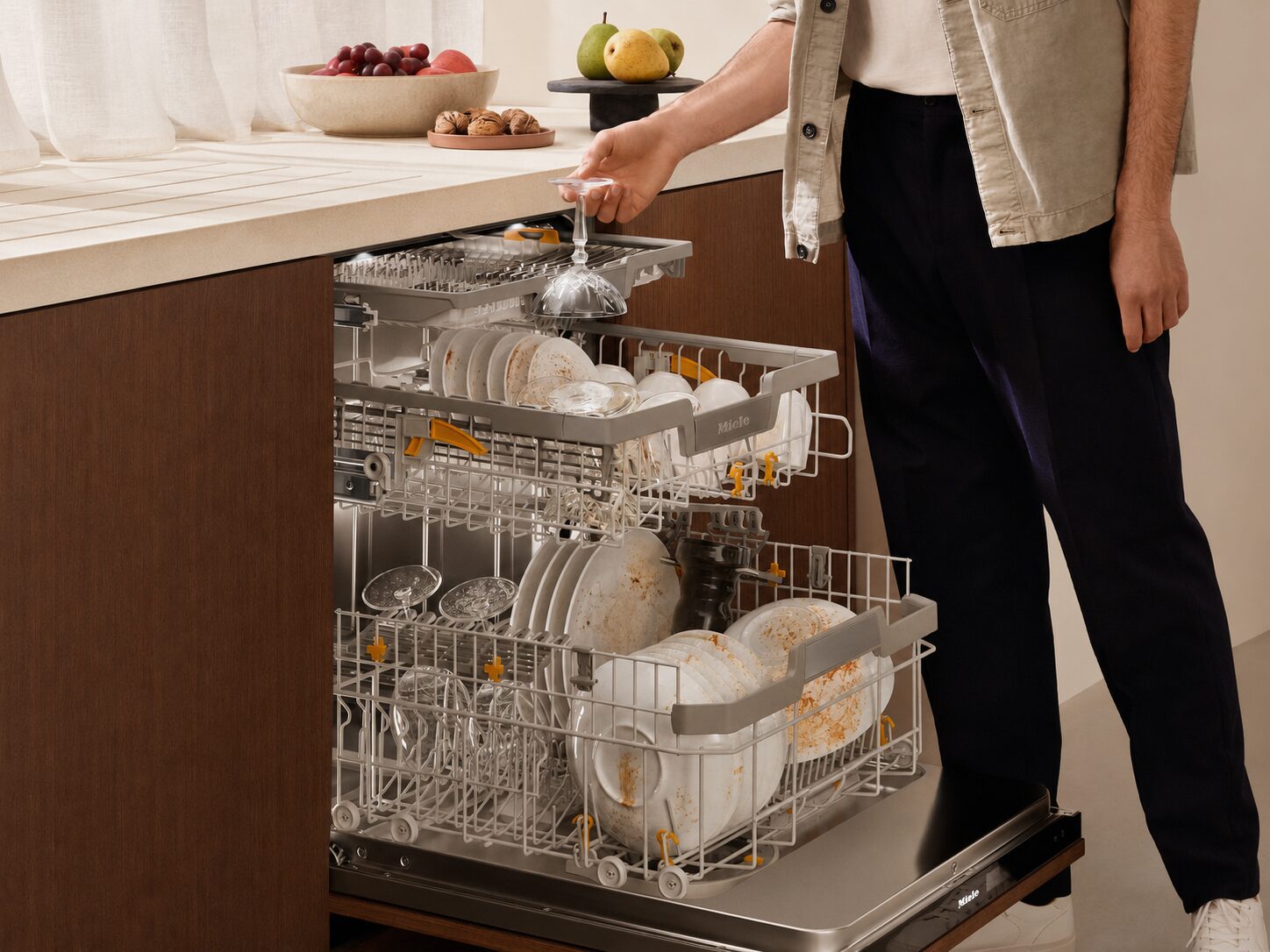
4. Dishes Are Loaded Incorrectly
The way dishes are loaded can affect both washing and drying performance. Bowls, cups, and containers may collect water when they are placed flat or at the wrong angle.
Overloading can also restrict airflow and prevent moisture from escaping after the wash cycle.
- ●Angle cups and bowls so water can drain
- ●Avoid stacking items too closely together
- ●Make sure spray arms can rotate freely
- ●Do not block the detergent or rinse aid dispenser
5. The Selected Program Uses Less Heat
Modern Miele dishwashers are designed to reduce water and energy consumption. Eco programs often use lower temperatures and longer wash times.
As a result, dishes may feel slightly wetter than they would after a Normal, Intensive, or higher-temperature cycle.
If drying performance improves when you select another program, the dishwasher may be functioning exactly as designed.
6. The Heating or Drying System Is Not Working Properly
If nearly every load comes out wet, regardless of the selected program, the dishwasher may not be producing or retaining enough heat.
Possible causes include:
- ●A faulty heating component
- ●A defective temperature sensor
- ●A fan or drying system malfunction
- ●An electronic control problem
Several internal components can produce similar symptoms, so professional testing is usually necessary to identify the exact cause.
Common Drying Problems at a Glance
| Symptom | Possible Cause | Recommended First Step |
|---|---|---|
| Water droplets on dishes | Low or empty rinse aid | Refill the rinse aid dispenser |
| Plastic containers stay wet | Plastic does not retain heat well | Allow extra drying time |
| Dishes dry inconsistently | Dirty filter or improper loading | Clean the filter and reload dishes |
| Entire load remains wet | Heating or drying system problem | Schedule professional diagnostics |
| Poor drying on eco cycles | Lower operating temperature | Try a standard or intensive cycle |
What Can You Check Yourself?
Before scheduling service, there are several simple maintenance checks worth performing.
- ●
Refill the rinse aid. Make sure the dispenser is not empty. - ●
Clean the dishwasher filter. Remove food debris, grease, and residue. - ●
Check the spray arms. Make sure they can rotate without hitting dishes. - ●
Review the loading pattern. Angle cups, bowls, and containers so water can drain. - ●
Try another program. Use a standard or higher-temperature cycle to compare results.
These basic checks often improve drying performance without requiring a repair.
Still finding wet dishes after every cycle?
Prime Fix provides professional Miele dishwasher diagnostics and repair throughout San Francisco and the Bay Area. We can inspect the heating system, sensors, controls, circulation, and drying components.
When Should You Call a Professional?
If your Miele dishwasher consistently leaves dishes wet after you have cleaned the filter, refilled the rinse aid, confirmed proper loading, and tried another wash program, the problem may involve internal components.
A technician can inspect the heating system, temperature sensors, circulation system, electronic controls, and drying components to identify the exact cause.
Professional service is especially recommended when the entire load remains wet, the water never becomes hot, the dishwasher stops during the cycle, or an error message appears.
Need Miele Dishwasher Repair in the Bay Area?
Our certified technicians specialize in Miele dishwasher repair, maintenance, and diagnostics throughout San Francisco and the Bay Area.
Whether your dishwasher is not drying properly, not heating correctly, leaving food residue, or simply not performing as expected, we can identify the problem and recommend the appropriate service.
Final Thought: Poor Drying Does Not Always Mean a Major Repair
A Miele dishwasher that is not drying dishes properly does not always need a major repair. Sometimes the solution is as simple as refilling the rinse aid, cleaning the filter, changing the way dishes are loaded, or selecting a different wash program.
If poor drying continues despite regular maintenance, contact Prime Fix for professional Miele dishwasher diagnostics and repair in San Francisco and the Bay Area.